


How Car Air Con Works
A car's air conditioning works like a fridge. A compressor, driven by the engine or, on an electric car, by its own motor, pressurises a refrigerant gas. The gas releases heat through a condenser at the front of the car, then expands and cools in the evaporator behind the dashboard. Air blown across the evaporator comes out of the vents cold and dry.
The refrigerant also carries a small amount of oil that lubricates the compressor. When the gas level drops, the system cools less well and the compressor can be put under strain.
On many electric cars, the same system also helps cool the battery. Our guide to EV and hybrid servicing explains why that matters.
How Often to Regas Your Air Con
Most manufacturers recommend a regas every two years. Kwik Fit estimates that around 10% of the refrigerant escapes each year through the hoses and seals, even when the system is in good condition. After a few years, the drop is enough to notice.
Check your handbook, as some manufacturers set their own interval or include an air con check at certain services. If you rarely use the air con, the system can still lose gas and the seals can dry out, so it is worth having it checked at least every couple of years.
Signs Your Air Con Needs Attention
- The air is not as cold as it was, or takes much longer to cool the car.
- No cold air at all. If the gas level is very low, a pressure switch stops the compressor running to protect it.
- A musty or damp smell when you switch the air con on.
- The windows take longer to demist. Air con dries the air, so a weak system makes misting worse.
- Unusual noises, such as rattling or loud clicking from the compressor.
- Water in the passenger footwell, which usually means a blocked drain from the evaporator.
Which Refrigerant Your Car Uses
| Refrigerant | Which cars | Notes |
|---|---|---|
| R134a | Most cars made before 2014 | Cheaper to regas |
| R1234yf | Almost every new car built since 1 January 2017, and many from 2014 to 2016 | Lower environmental impact, but more expensive |
Cars built between 2014 and 2016 could use either, because manufacturers changed over gradually. A small number of newer models, mainly electric cars with heat pumps, use carbon dioxide (R744) instead. There is usually a label under the bonnet that shows the type of refrigerant and how much the system holds. The two gases cannot be swapped, so the garage must use the one your car was built for.
What Happens During a Regas
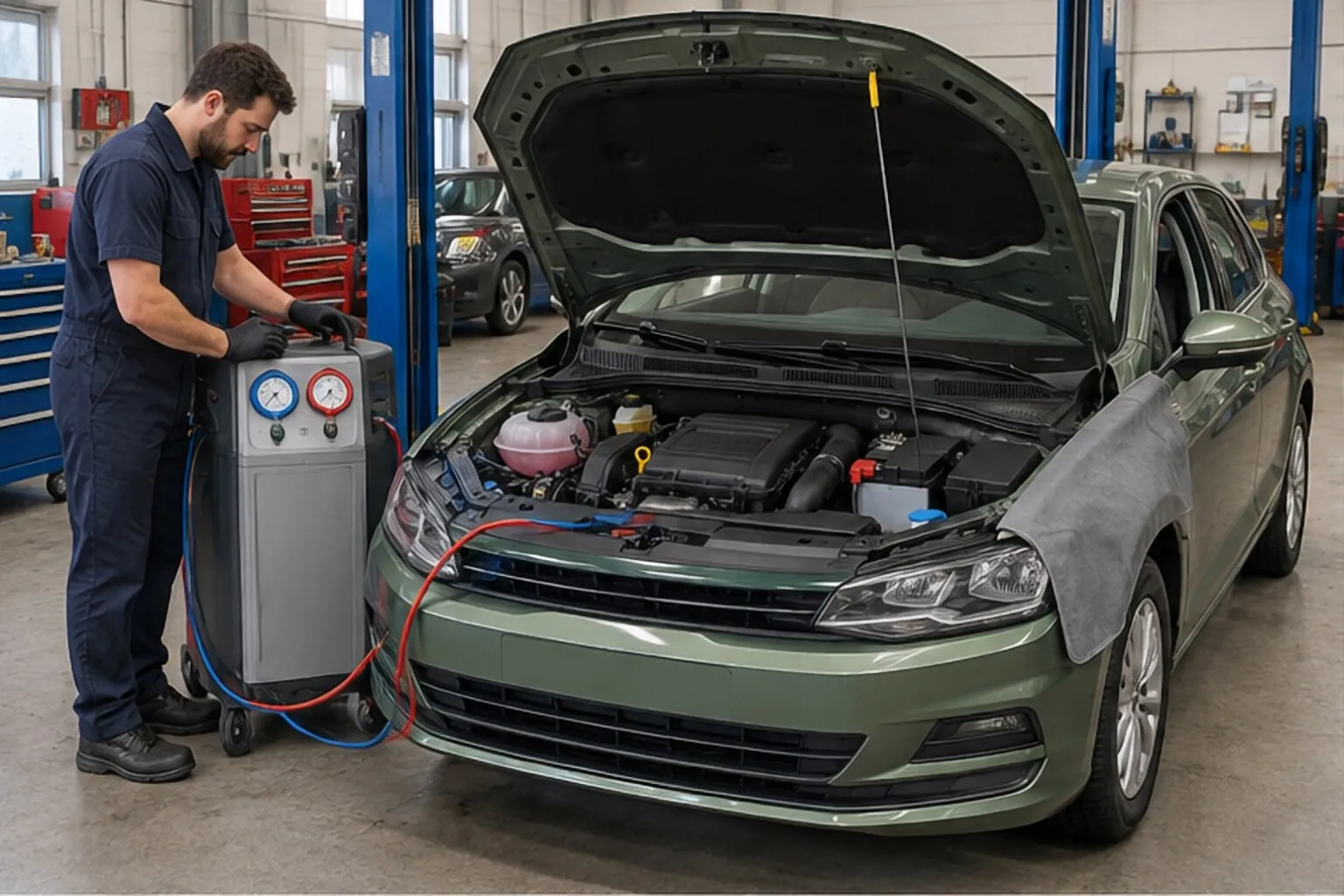
The old refrigerant is recovered with a machine and weighed. The amount recovered shows how much has been lost.
The system is held under vacuum for a set time. If it will not hold the vacuum, there is a leak.
The system is recharged with the exact weight of refrigerant the manufacturer specifies, along with the right compressor oil.
Many garages add a UV dye, which makes any future leak easy to find with a lamp.
The vent temperature is checked with the engine running and the air con on.
Refrigerant must not be released into the air, so the work is done with recovery equipment by trained technicians. A regas usually takes under an hour.
Many garages also offer an antibacterial treatment, which deals with the musty smell. Replacing the cabin filter at the same time helps too.
What a Regas Costs
- R134a regas: about £42 to £100 through BookMyGarage, based on bookings in the last year.
- R1234yf regas: about £59 to £151 through BookMyGarage.
- Antibacterial treatment: often added for a small extra charge.
- Leak repairs and compressor replacement: these are repairs rather than maintenance, and a compressor can cost several hundred pounds or more.
Prices change, so check the current figures when you book.
DIY Regas Kits
Top-up cans are sold for some systems, but they are a poor substitute for a proper regas. A can adds gas without recovering the old refrigerant, testing for leaks or measuring how much the system holds. Too much refrigerant can damage the compressor just as too little can.
R1234yf is also mildly flammable and needs specific equipment. For most owners, a garage regas is the safer and more reliable choice.
How It Shows in Your Service History
An air con regas usually appears as a separate line on an invoice, sometimes with the weight of refrigerant recovered and added. Upload the invoice to your free digital service book, so it sits alongside the car's services. That figure is useful. If very little gas was recovered, the system had lost most of its charge, which can point to a leak.
Two or more regasses within a year or so suggest a leak that has not been fixed. A repair invoice for a condenser, pipe or compressor shows the cause was dealt with. When you are buying a used car, a Service History Check shows its recorded services, so you can see whether the paperwork the seller hands over is complete.
Buying Used: What to Check
- Test the air con on a test drive, even in winter. Set it to the coldest setting with the fan on full. The air from the vents should feel noticeably cold within a few minutes.
- Sniff for a musty smell when it first comes on.
- Listen for noise from the engine bay when the air con switches on.
- Look for regas and repair invoices in the history. Frequent regasses mean a leak.
- If it does not work, do not accept "it just needs a regas" at face value. It may be a leak or a failed compressor, which can cost far more. Price it accordingly. Our guide to negotiating on price based on service history explains how.