What Brake Fluid Does
When you press the brake pedal, you are not pushing the brake pads directly. You are pushing a piston in the master cylinder, which pushes brake fluid along pipes and hoses to each wheel. Because liquid cannot be squashed, that pressure arrives at the brake callipers and pushes the pads against the discs.
The system only works if the fluid stays a liquid. Air or vapour can be squashed, so a bubble anywhere in the system soaks up some of the pedal's movement instead of passing it on. That is what a spongy brake pedal feels like.
On many manual cars the same fluid, from the same reservoir, also operates the clutch.
Why Brake Fluid Needs Changing
Most brake fluid is designed to absorb water. Moisture gets into the system slowly, through the hoses, the seals and the reservoir cap. Brake fluid soaks it up and spreads it through the fluid, rather than letting it collect in one place where it could freeze or rust a component.
The cost is a lower boiling point. Hard braking makes the brakes very hot, and some of that heat passes into the fluid in the callipers. If the fluid boils, it forms vapour bubbles, and the pedal can go soft or sink towards the floor just when you need it most.
The standards brake fluid is made to set two minimum boiling points. The "dry" figure is for new fluid. The "wet" figure is measured after the fluid has absorbed a set amount of water, which fluid makers describe as roughly its state after a year of use.
| Fluid | Minimum dry boiling point | Minimum wet boiling point |
|---|---|---|
| DOT 3 | 205°C | 140°C |
| DOT 4 | 230°C | 155°C |
| DOT 5.1 | 260°C | 180°C |
Water also causes corrosion inside the system, in parts such as the callipers and the ABS unit. Replacing an ABS unit costs far more than a fluid change.
How Often to Change Brake Fluid
Most manufacturers set the interval by time, typically every two years, regardless of mileage. Volkswagen, for example, asks for the first change at three years old and every two years after that. Fluid absorbs moisture whether the car is driven or not, which is why low mileage does not stretch the interval.
The interval is in your service schedule or handbook. On cars with a variable service schedule, the car may track the brake fluid separately and show its own reminder.
Brake fluid is often treated as additional work, not part of the standard service price. A garage may recommend it at the service and charge it separately, so check the invoice to see whether it was done. Electric and hybrid cars need it too. They use their friction brakes less, thanks to regenerative braking, but the fluid still ages.
How to Check Your Brake Fluid Level
This takes a minute. Do it with the car parked on level ground and the engine off.
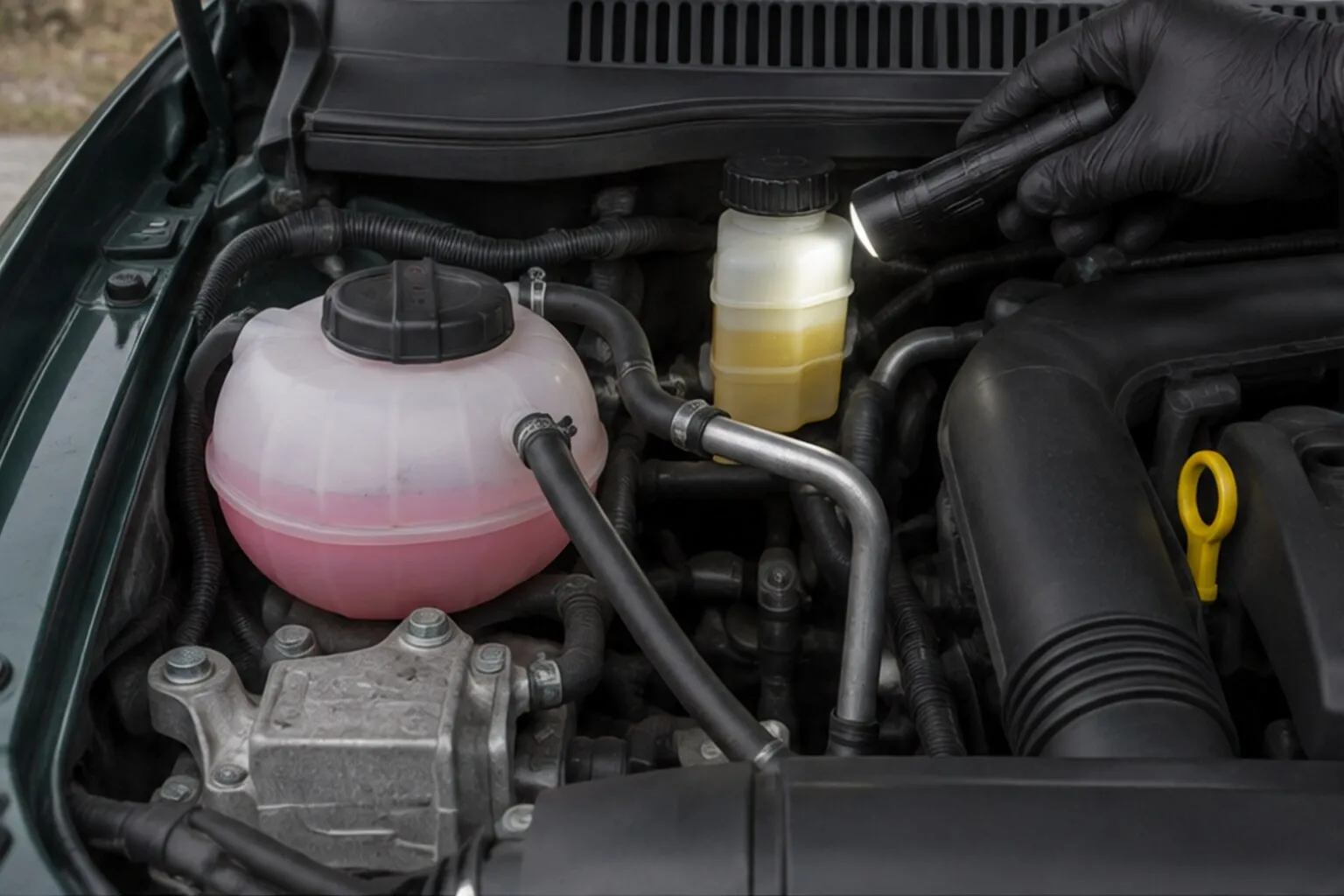
Open the bonnet and find the reservoir. It is usually a small translucent plastic tank near the back of the engine bay on the driver's side. The cap often shows a brake symbol or says "brake fluid", with the fluid type.
Read the level against the marks. The fluid should sit between MIN and MAX. You can usually see the level through the side of the reservoir without opening it.
Look at the colour. New fluid is clear to pale amber. Fluid that has turned dark brown is old or contaminated and is due a change.
Leave the cap on unless you need to top up. Every time the reservoir is opened, more moist air gets in.
The level drops slowly over time as the brake pads wear, because the callipers hold more fluid as the pads get thinner. A level a little above MIN on a car due new pads is normal. A level that drops quickly, or falls below MIN, needs checking straight away.
Topping Up Brake Fluid
If the level is at or below MIN, top it up with the type shown on the cap or in the handbook. Wipe the cap and the area around it first, so no dirt falls in. Use fluid from a sealed bottle, as an opened bottle absorbs moisture from the air. Fill to between the marks and do not go past MAX.
Be careful not to spill it. Brake fluid strips paint, so wipe up any drips at once and rinse with water. It is also harmful if swallowed, and it irritates the skin and eyes, so wear gloves.
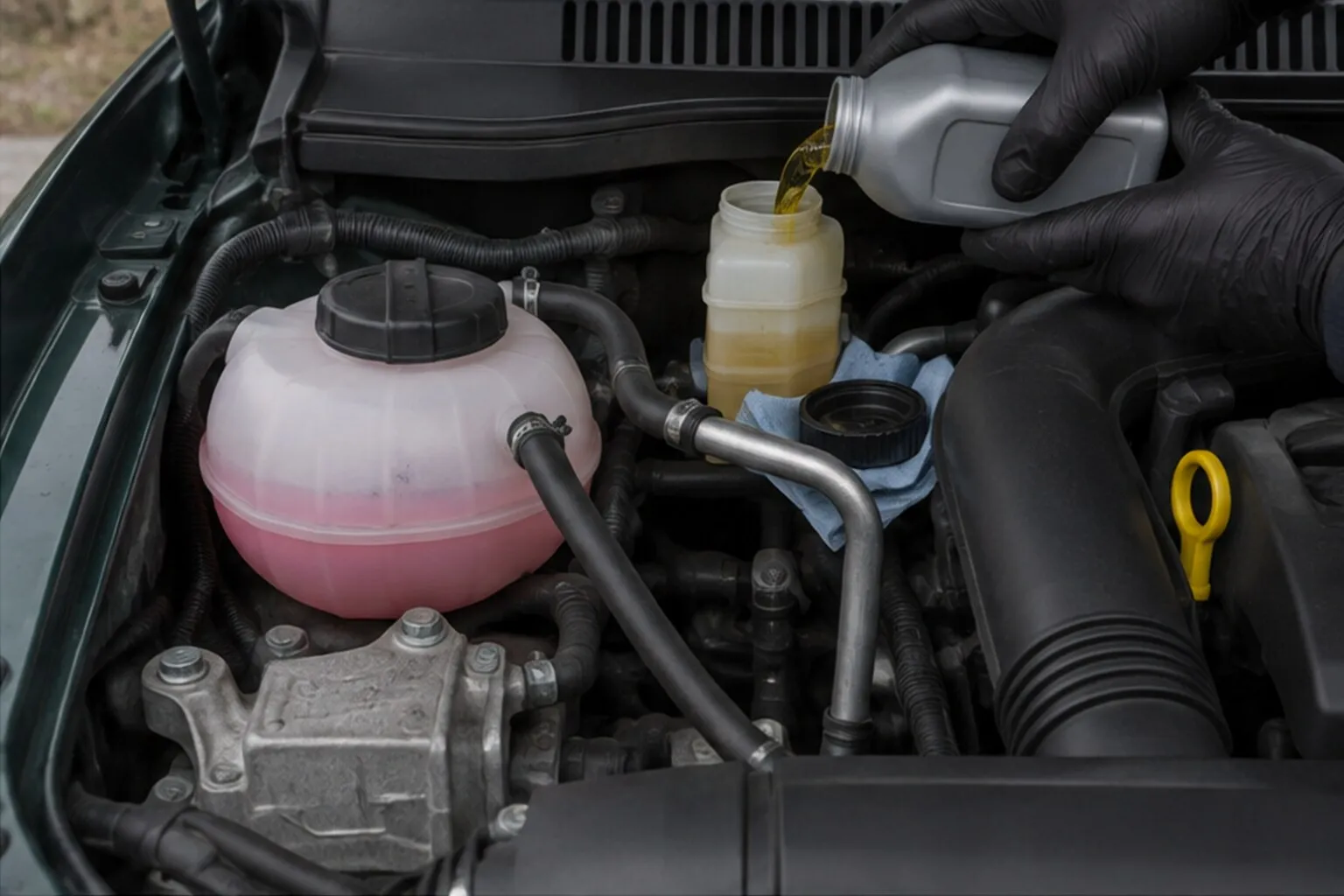
Topping up is a short-term fix. If you need to do it more than once between services, something is wrong. The two usual causes are worn brake pads and a leak. Either way, have the brakes checked.
Brake Fluid Types
Most modern cars use DOT 4, and some use DOT 5.1. DOT 3, DOT 4 and DOT 5.1 are all glycol-based and will mix, but always use the type your car specifies. Using a lower grade than the car needs can lower the boiling point.
DOT 5 is different. It is silicone-based, does not absorb water and must never be mixed with the others. Very few road cars use it. Despite the similar name, DOT 5.1 is not DOT 5.
Some cars specify a particular version, such as DOT 4 with a lower viscosity for cars with stability control. The handbook or the reservoir cap gives the details.
Brake Fluid and the MOT
The MOT tester checks the fluid level, but only where the reservoir is see-through or has a level indicator. They do not remove the cap and they do not test the fluid's condition.
| MOT item | Defect category |
|---|---|
| Brake fluid below the minimum mark | Minor |
| Brake fluid significantly below the minimum mark | Major (fail) |
| Brake fluid not visible | Dangerous (fail) |
| Reservoir cap missing | Major (fail) |
| Brake fluid warning light on or faulty | Minor |
| Brake fluid clearly contaminated | Major (fail) |
The contamination item only applies when the tester can clearly see the fluid is contaminated, and on many cars they cannot. So a car can pass its MOT with fluid that is years overdue. The service history is the only reliable way to know when it was last changed. You can see a car's past MOT results and advisories with our free MOT history check.
Warning Signs of a Brake Fluid Problem
- A soft or spongy pedal, or one that travels further than it used to.
- A pedal that sinks slowly when you hold it down at the lights.
- The red brake warning light staying on with the parking brake released. On many cars this means the fluid level is low.
- Fluid on the inside of a wheel or tyre, or drips near a wheel, which can mean a leaking calliper or hose.
- The brakes fading on a long downhill stretch.
If the pedal goes soft or the warning light comes on, have the car checked before you drive it any further than you must. Our guide to dashboard warning lights covers the brake warning light in more detail.
What a Brake Fluid Change Costs
Booking sites put the average brake fluid change at around £50 to £65 at an independent garage, with most quotes falling between about £40 and £90. Dealers usually charge more. The job usually takes under an hour, and it is often cheaper when done at the same time as a service.
Changing Brake Fluid Yourself
Checking and topping up are DIY jobs. Changing the fluid is a different matter. The old fluid has to be pushed out of every calliper in turn, in the right order, without letting any air into the system. On many modern cars, air that reaches the ABS unit can only be cleared with a diagnostic tool.
If you have done it before and have the right equipment, such as a pressure bleeder, it is possible at home. If not, this is a job for a garage. A mistake leaves you with brakes that do not work properly, and you may not find out until you need them.
Old brake fluid is hazardous waste. Take it to a household waste recycling centre that accepts it, and never pour it down a drain.
How a Brake Fluid Change Shows in Your Service History
A brake fluid change should appear as its own line on the invoice, such as "Brake fluid replaced, DOT 4", with the date and mileage. In paper service books it often has a separate section or box for additional work, which is easy to leave blank. Some garages also put a sticker under the bonnet showing the date of the change.
Invoice
What a brake fluid change looks like on an invoice
- Brake fluid replaced, with the fluid type, such as DOT 4
- The date and mileage of the change
- A date sticker under the bonnet, if the garage uses one
Because the interval is every two years rather than every service, the change should show at every other annual service on most cars. Count back through the history: on a six-year-old Volkswagen, you would expect to see it at three and five years old.
Example
A six-year-old Volkswagen: where the brake fluid changes should be
- Year 1(Service only)
- Year 2(Service only)
- Year 3Brake fluid changed(Service with brake fluid change)
- Year 4(Service only)
- Year 5Brake fluid changed(Service with brake fluid change)
- Year 6(Service only)
- Service with brake fluid change
- Service only
If the history has a long run of services with no brake fluid change, the fluid is probably original or well overdue. That is worth knowing, and it is worth raising on price. Our guide to negotiating on price based on service history explains how.
Buying a Used Car: What to Check
- Look for the brake fluid change in the history, roughly every two years from the first one.
- Check the reservoir. The level should be between the marks and the fluid should not be dark brown.
- Press the brake pedal with the engine running. It should feel firm and stop well above the floor.
- Look for the date sticker under the bonnet, and ask the seller when it was last done.
Check the history before you buy
A Service History Check shows recorded services for the car, so you can see what has and has not been done.