
The 12 Winter Checks at a Glance
| # | Check | What good looks like | Can you do it yourself? |
|---|---|---|---|
| 1 | Your car's records | No open MOT advisories, and no service due before spring | Yes, online |
| 2 | Battery | Starts first time, and has been tested if over four years old | Visual check yes; test at a garage or with a tester |
| 3 | Tyre tread | At least 3mm across the middle three-quarters of each tyre | Yes, with a gauge or a 20p coin |
| 4 | Tyre pressure and condition | At the handbook pressure, set when cold, with no cuts or bulges | Yes |
| 5 | Coolant and antifreeze | Level between MIN and MAX, at 50/50 antifreeze strength | Level yes; strength with a cheap tester |
| 6 | Screenwash | Bottle full of a winter screenwash | Yes |
| 7 | Wiper blades | Clear the screen in one sweep, with no smears or splits | Yes |
| 8 | Lights and number plates | Every bulb working, lenses and plates clean | Yes |
| 9 | Windscreen and glass | No chips in the driver's view, and demists quickly | Check yes; repair at a specialist |
| 10 | Engine oil | Between the marks on the dipstick | Yes |
| 11 | Door seals and locks | Doors open without sticking or tearing the seals | Yes |
| 12 | Winter kit and fuel | Kit in the boot and at least a quarter of a tank | Yes |
Most of these take a few minutes each. Anything that fails a check is cheaper to sort now than at the roadside in January.
1. Start With Your Car's Records
Before you open the bonnet, look at what is already known about the car. Two records tell you most of what you need.
Your last MOT advisories. An advisory is something the tester saw wearing but which still passed: a tyre close to the legal limit, a brake pipe with surface corrosion, a perished wiper blade. Advisories stay on the car's public MOT record, and winter is when they turn into failures and breakdowns. Put your registration into our free MOT history check and deal with anything listed before the cold arrives.
When the car was last serviced, and what was done. If a service is due in the next two or three months, bring it forward. A service covers much of this checklist anyway, so the battery test, coolant check and tyre inspection happen before you need them. While you have the history open, look for when the battery was last replaced and when the coolant was last changed. The AA notes that some antifreeze types need changing after only two years, while most modern cars use long-life coolant, so check the interval in your service schedule.
If you have bought the car recently and do not know what has been done, a service history check pulls the manufacturer's service records by registration.
2. Battery
Battery faults are the most common reason drivers call out the RAC, all year round, and cold weather pushes the numbers up. Low temperatures slow the chemical reaction inside a battery at the same time as the heater, lights, heated screens and wipers ask more of it. A cold engine is also harder to turn over.
How to check it:
- Age. The RAC advises testing any battery over four years old, and the AA says batteries rarely last much beyond five years. Most batteries carry a date on a label or stamped into the case. If you cannot find one, look for the battery on your invoices or service history.
- How the car starts. A slow, laboured crank on cold mornings is the classic warning sign. So is a battery warning light, or interior lights that dim sharply as you start the engine.
- Terminals. Look for white or green crusty corrosion on the terminals, and check the clamps are tight.
- A proper test. Many garages and fast-fit centres will test a battery while you wait, and a plug-in battery tester gives a rough reading at home.
If the car sits unused for weeks at a time, a battery conditioner or trickle charger keeps it topped up. On a cold start, the AA suggests switching off the lights, wipers and heated rear screen first, cranking in bursts of about five seconds, and waiting 30 seconds between attempts.
3–4. Tyres: Tread, Pressure and Condition
Your tyres are the only part of the car touching an icy road, and the law on them is strict.
Tread depth. The legal minimum for a car is 1.6mm across the middle three-quarters of the tyre, all the way round. Each illegal tyre can bring a fine of up to £2,500 and three penalty points. For winter, the AA and Which? recommend at least 3mm, because deeper grooves clear water and slush better. A tread depth gauge costs a few pounds and gives an exact reading. The 20p test is a quick check for the legal limit: put a 20p coin into the main grooves in a few places, and if you can see the coin's outer band, the tread may be below 1.6mm. It will not tell you whether you have 3mm, so a gauge is better for winter.
Pressure. Tyre pressure falls with the temperature, by roughly 1 to 2 PSI for every 10°C according to Continental. Check pressures every couple of weeks in winter, with the tyres cold (before you drive, or after the car has been parked for a few hours). Set them to the figure in your handbook or on the label inside the driver's door or fuel flap. Do not let air out for more grip in snow: the AA says it does not work and is not safe.
Condition. Look for cuts, bulges, cracks in the sidewall and anything stuck in the tread. Cold weather makes existing damage worse. If you have a spare, check that too.
Do you need winter tyres? Not by law in the UK. Winter tyres use a softer rubber that stays grippy in the cold and carry the three-peak mountain snowflake (3PMSF) symbol. All-season tyres are a compromise: better than summer tyres on cold, wet roads and in light snow, without swapping sets twice a year. If you live somewhere that sees regular snow, either is worth considering. Snow socks are a cheaper standby to keep in the boot. Snow chains are legal but only for compacted snow, and must come off as soon as you reach a clear road or they will damage the road and the car. If you drive to Europe, some countries require winter tyres or chains, so check before you go.
5. Coolant and Antifreeze
Coolant does two jobs: it stops the engine overheating and, mixed with antifreeze, stops the water in it freezing. The AA says a 50/50 mix of antifreeze and water protects an engine down to about -34°C. The risk is dilution. Top up with plain water a few times over the summer and the mix gets weaker, until a hard frost freezes it. Frozen coolant can crack a radiator or even the engine block.
How to check it:
- Wait until the engine is cold. Never open the coolant cap on a hot engine, because the system is under pressure.
- Find the expansion tank, usually a translucent plastic bottle with MIN and MAX marks, and check the level sits between them.
- Check the strength with an antifreeze tester. They cost a few pounds from a motor factor.
- If it needs topping up, use the coolant type your handbook specifies, mixed to the right ratio, or a ready-mixed version. Do not mix different types, as some can react and form sludge.
If the level keeps dropping, there is a leak somewhere and the car needs a garage. The AA lists two signs that a cooling system has frozen: a continuous squeal soon after starting, which can mean a frozen water pump, and the engine overheating a few miles from home, which can mean a frozen radiator. In either case, stop and let it thaw.
6–7. Screenwash and Wiper Blades
Winter roads throw salt and grime at the windscreen, and a low sun turns any smear into glare. Your screenwash and wipers do more work now than at any other time of year.
Screenwash. Fill the washer bottle with a winter screenwash, mixed at the strength the label gives for the temperatures you expect. Plain water freezes in the bottle and the jets. Never put engine antifreeze in the washer bottle, because it can damage paintwork. While the bonnet is up, check that the jets hit the screen and are not blocked.
Wiper blades. Run a finger along each rubber edge. It should be smooth, not split, hardened or nicked. Blades that smear, judder or leave streaks need replacing, which is a five-minute job on most cars. On frosty nights, do not park with the wipers set to automatic: the AA warns that blades frozen to the screen can be damaged, along with the wiper motor, when the car starts. Free them with de-icer before you switch them on.
Wipers and washers are part of the MOT, so a blade that has given up is worth sorting before your next test as well.
8. Lights and Number Plates
In winter you do more of your driving in the dark, and being seen matters as much as seeing. Walk round the car with the lights on and check every one: dipped and main beam, sidelights, indicators, brake lights, reversing lights, fog lights and the number plate light. To check the brake lights on your own, reverse up to a garage door or shop window and watch the reflection, or ask someone to stand behind the car.
Clean the lenses after mucky journeys, because road grime dims headlights. Rule 229 of the Highway Code says your lights must be clean and your number plates clearly visible and legible. An obscured or unreadable number plate can bring a fine of up to £1,000.
Fog lights are for when visibility is seriously reduced, generally when you cannot see more than 100 metres. Rule 226 says you must switch them off when visibility improves, because they dazzle other drivers.
9. Windscreen and Glass
Look for chips and cracks, especially in the area the wipers sweep. The AA warns that chips can get worse in cold weather, and a chip repaired now is usually far cheaper than a new screen later. It matters for the MOT too: damage larger than 10mm in the strip directly in front of the driver, or larger than 40mm elsewhere in the area the wipers sweep, is a fail.
Clean the inside of the glass as well. A greasy film mists up faster and smears badly in low sun. Use the air conditioning with the heater to demist, since it dries the air and clears the screen faster. Check that the heated rear screen works, and the heated windscreen if your car has one.
10. Engine Oil
Park on level ground and check the oil with the engine cold, or a few minutes after switching off. Pull out the dipstick, wipe it clean, push it fully back in, then pull it out again and read the level. It should sit between the minimum and maximum marks. Top up a little at a time with the oil grade in your handbook, rechecking as you go, because overfilling causes problems of its own. Some newer cars have no dipstick and show the oil level on the dashboard instead.
If your service is close, the oil and filter change will be part of it. A car that needs regular top-ups between services is worth mentioning to your garage.
11. Door Seals and Locks
Frozen door seals are a winter nuisance, and yanking a frozen door open can tear the rubber. Wipe the seals clean and treat them with a silicone spray or rubber conditioner, which helps stop them freezing to the door. If a lock or handle freezes, use a lock de-icer rather than hot water. Keyless cars avoid frozen locks, but their seals can still freeze shut.
12. Winter Kit and Fuel
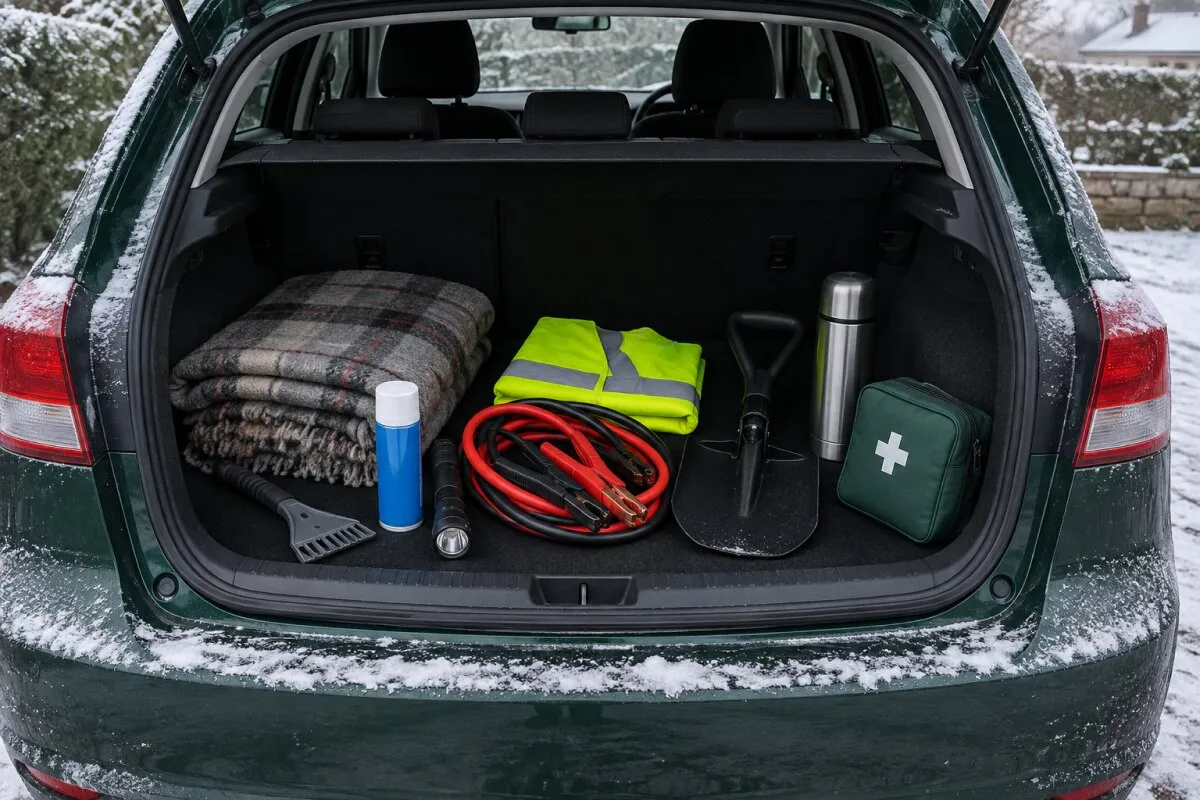
Rule 228 of the Highway Code suggests carrying an emergency kit in winter: de-icer and an ice scraper, a torch, warm clothing and boots, a first aid kit, jump leads, a shovel, a warm drink and emergency food. It is also worth adding:
- a fully charged phone, plus a power bank or in-car charger
- a blanket
- a hi-vis vest or jacket
- a warning triangle (never put one out on a motorway)
- an old rug or sack to put under the driving wheels for grip if you get stuck
- snow socks, if you live somewhere that gets regular snow
- your breakdown provider's number, saved in your phone
The AA recommends keeping at least a quarter of a tank of fuel in winter, in case you are held up for hours. In an electric car, the equivalent is not letting the charge run low before a long trip.
Electric and Hybrid Cars in Winter
Most of this checklist applies to electric and hybrid cars too: tyres, wipers, screenwash, lights and glass. They also have a conventional 12-volt battery alongside the big traction battery, and the RAC points out that it can go flat in winter just like a petrol car's, especially if the car sits unused.
The bigger change is range. A cold battery is less efficient, and heating the cabin takes energy that a petrol car gets for free from its engine. When What Car? tested the same three electric cars in summer and winter, their range was 18% lower on average in the cold. Cars with a heat pump tend to lose less.
To get the most from an EV in winter:
- Precondition the cabin, and the battery if your car can, while it is still plugged in, so the heat comes from the charger rather than the battery.
- Use the heated seats and steering wheel, which use less energy than heating all the air in the cabin.
- Keep the charge above 20% in cold spells. The RAC says leaving a high-voltage battery below that for long periods in the cold can harm its health.
- Allow extra time at rapid chargers, because a cold battery charges more slowly. Some cars warm the battery automatically when you navigate to a charger.
Every Cold Morning: Clearing Ice and Snow Legally
The checks above are done once. This part is every frosty morning.
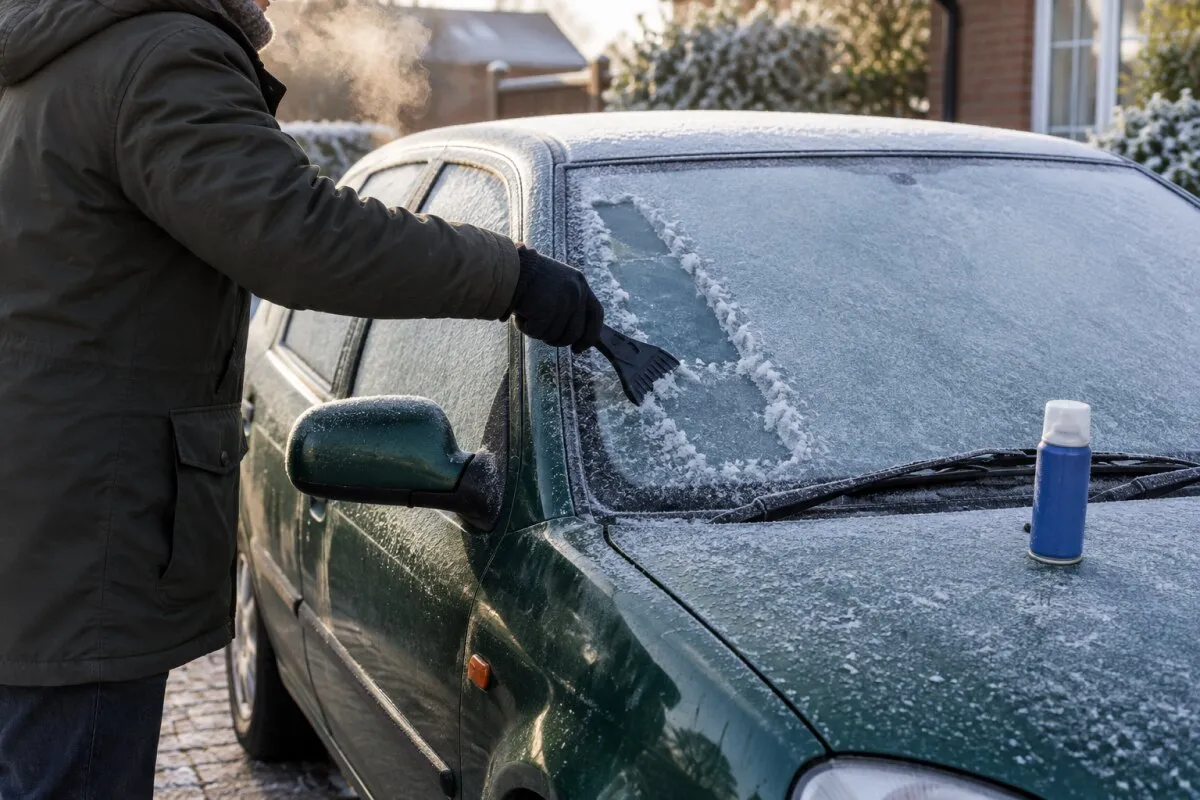
Clear all of it, not a porthole. Rule 229 of the Highway Code says you must be able to see, so clear snow and ice from all your windows. Your lights must be clean and your number plates readable. Clear the mirrors and demist the inside of the glass too. Driving without a clear view can lead to a £100 fine and three penalty points.
Brush the snow off the roof. There is no specific law against driving with snow on the roof. But the Highway Code tells you to remove snow that might fall into the path of other road users, and if it slides down over your windscreen or blows into another driver's view, you could be penalised.
Do not use hot water. Boiling or even warm water on frozen glass can crack it, particularly if there is already a chip, and it can refreeze on the screen. Use a scraper and de-icer, with the heater and air conditioning running.
Stay with the car. Running the heater while you scrape is fine, but Rule 123 of the Highway Code says you must not leave a parked vehicle unattended with the engine running. Councils can fine drivers for leaving engines running unnecessarily on a public road:
| Where | Fixed penalty for idling |
|---|---|
| England | £20, rising to £40 if not paid in time |
| Wales | £75 to £150, set by each council (from 30 September 2026) |
| Scotland | £20 |
The idling offence covers public roads, not your own driveway. But a running car with the key inside is easy to steal wherever it is parked, and insurers may refuse to pay out if it is stolen that way.
Allow time. The AA suggests leaving at least 10 minutes early to de-ice properly. Once you are moving, remember the Highway Code's warning that stopping distances on ice can be ten times longer than on a dry road.
Keep a Record of What You Have Done
Winter jobs are easy to forget by spring: a new battery in November, wiper blades in December, a pair of tyres in January. Each one is part of your car's maintenance history, and a future buyer will want to see them. Garage work comes with an invoice. Jobs you do yourself leave no trace unless you keep the receipt and note the mileage.
Our free digital service book keeps all of it in one place. Photograph a garage invoice or a parts receipt, and the details are read into a proposed record that you check, edit and confirm. Add the mileage if the receipt does not show it. Work you know was done but cannot document can be added by hand, and it is labelled as a manual entry so nobody mistakes it for documented evidence. When you sell, share the book by link or download it as a PDF. It is free for your first car.
If you service the car yourself, our guide to filling in a car service book explains how to record owner-done work honestly.
Buying a Used Car This Winter
Winter is a good time to see how a car really behaves. Ask the seller not to run the engine before you arrive, so you hear a genuinely cold start: a slow, laboured crank points to a tired battery. With the engine cold, check the coolant level, look for the battery's date, measure the tyre tread and look up the MOT advisories. Then compare what you find with the service history. A record showing a recent battery, a coolant change on schedule and tyres replaced in good time tells you the last owner kept on top of things.
A service history check shows the manufacturer's service records by registration. Pair it with a vehicle history check to see outstanding finance, write-offs and mileage records.
Find the Right Parts for Your Car
If your checks turn up a tired battery, worn wiper blades, a failed bulb or tyres close to the limit, these retailers show the parts that fit your car from its registration number:
- Halfords car batteries: batteries by registration, with fitting in store or at home in many areas.
- Halfords wiper blades: front and rear blades by registration.
- Halfords antifreeze and coolant: enter your registration to narrow the range to coolants that suit your car.
- Halfords car bulbs: bulbs by registration.
- GSF Car Parts car batteries and Euro Car Parts car batteries: batteries by registration or by make and model.
- Kwik Fit tyres: tyres by registration, with fitting at a centre or at home.
Registration lookups rely on third-party vehicle data and are occasionally wrong. Check what they suggest against your handbook or the part already fitted before you buy.