

What Engine Oil Does and Why It Needs Changing
Engine oil does four jobs at once. It lubricates the moving parts, it helps cool parts the coolant does not reach, it cleans by holding soot and dirt in suspension, and it protects metal surfaces from corrosion.
Oil does not last forever. Heat breaks it down, the additives that protect the engine get used up, and it gradually fills with soot, fuel, moisture and tiny particles of metal. The filter catches the larger particles, but it fills up too. Old oil protects the engine less well, and in the worst cases it turns to sludge that blocks the narrow passages oil needs to flow through.
Some engines are more sensitive than others. Turbocharged engines run their turbo bearings on engine oil at very high temperatures. Some engines, including Ford's 1.0 EcoBoost and Stellantis's 1.2 PureTech, run their cambelt in engine oil, and on these the wrong oil or overdue oil can damage the belt. Our guide to cambelt replacement covers those engines in more detail.
How Often to Change Your Oil
The right interval is the one in your car's service schedule. Manufacturers set an interval in both time and mileage, and the oil is due at whichever comes first.
Volkswagen's UK schedules are a useful example of how this works:
| Schedule | When the oil is changed | Who it suits |
|---|---|---|
| Fixed | Every 12 months or 10,000 miles, whichever comes first | Cars covering fewer than about 9,300 miles a year, or mostly short journeys and town driving |
| Flexible | When the car says so, up to 24 months or 18,600 miles | Cars that regularly cover more than 25 miles a day |
Other manufacturers use similar systems with different names and numbers. Our guide to service reminders and recording your service explains how fixed and variable schedules work.
The old advice to change oil every 3,000 miles dates from older engines and oils. Modern cars go much further. But low mileage is not a reason to skip a change. Oil ages even when the car is parked, which is why the time limit matters as much as the mileage.
Short journeys count double. An engine that rarely warms up properly collects moisture and fuel in its oil. Diesels with a particulate filter add another problem. When the filter cleans itself, extra fuel is injected, and if the process is cut short by a short journey some of that fuel can end up in the oil. That thins the oil and raises the level on the dipstick. If your car does mostly short trips, ask your garage whether an extra oil change between services makes sense.
Choosing the Right Oil
Oil bottles carry two kinds of information, and you need both to match your handbook.
Viscosity, such as 5W-30 or 0W-20, describes how thick the oil is. The first number, with the W for winter, shows how well it flows when cold. The lower it is, the faster it reaches the moving parts on a cold start. The second number shows how thick it stays at normal running temperature.
Specification describes what the oil has been tested to do. It is the more important of the two. Your handbook may give an industry standard, such as ACEA C3, a manufacturer approval, such as VW 504 00, Ford WSS-M2C948-B or BMW Longlife-04, or both. Two oils with the same viscosity can meet very different specifications.
Cars with a diesel particulate filter, or a petrol particulate filter, usually need an oil from the ACEA C range. These oils are made with lower levels of the ash-forming additives that can clog the filter. Using an oil from the wrong range can shorten the filter's life.
Some manufacturers are also changing their codes. Stellantis, which owns Peugeot, Citroën, Vauxhall and Fiat, is replacing its older oil specifications with a single new series, so newer bottles may show a different code from your handbook. If you are unsure, ask a motor factor or check the oil maker's lookup tool using your registration.
Most oils that meet modern manufacturer specifications are fully synthetic. The label "synthetic" on its own does not tell you whether the oil is right for your car. The specification does.
Signs Your Oil Needs Changing
- The service reminder appears, as a spanner symbol or a message.
- The oil level warning light comes on. This is usually amber or yellow and means the level is low. Top up with the correct oil and get the car checked.
- The level on the dipstick has risen above the maximum mark, which can mean fuel or coolant in the oil. Have it checked before driving far.
- The oil looks milky or grey, which can mean coolant is getting into it. That needs investigating.
- It is more than a year since the last change, whatever the mileage.
A red oil pressure warning light is different. It means the engine has lost oil pressure. Stop as soon as it is safe, turn the engine off and do not drive on. Our guide to dashboard warning lights explains the difference.
Do not judge the oil by its colour alone. Fresh oil darkens quickly, and diesel oil turns black almost immediately because it holds soot. Dark oil is often doing its job.
What an Oil and Filter Change Costs
Booking sites put the average oil and filter change at an independent garage at around £100 to £130, with figures varying by site and car. Expect to pay more at a franchised dealer, or for a car that needs a large quantity of a specialist oil.
Doing it yourself, the main costs are the oil and the filter. Most family car engines take around 4 to 5 litres, and a good quality oil to the right specification costs roughly £35 to £50 for 5 litres. A filter is usually £5 to £20. You will also need a new sump plug washer, a drain pan, a filter removal tool and somewhere legal to dispose of the old oil.
An oil and filter change on its own is not a service. A service adds a set of inspections and other jobs. If you book an oil change only, it will appear in the history as an oil change rather than an interim or full service.
How to Change Your Engine Oil and Filter
This is the most common DIY servicing job, and on many cars it is straightforward. On some, the filter is buried, the drain plug is behind an undertray or the oil is changed from above with an extraction pump. Check a workshop manual for your car before you start.
You will need:
- The correct oil and filter, plus a new sump plug washer or plug.
- A drain pan and a sealed container for the old oil.
- A spanner or socket for the sump plug, and a torque wrench.
- A filter removal tool, if the filter is a canister type.
- Axle stands or ramps, and wheel chocks.
- Gloves, rags and a funnel.
- Time: about an hour
- Difficulty: moderate
Warm the engine for a few minutes. Warm oil drains faster and carries more dirt with it. Do not let it get fully hot, as oil at running temperature can burn you.
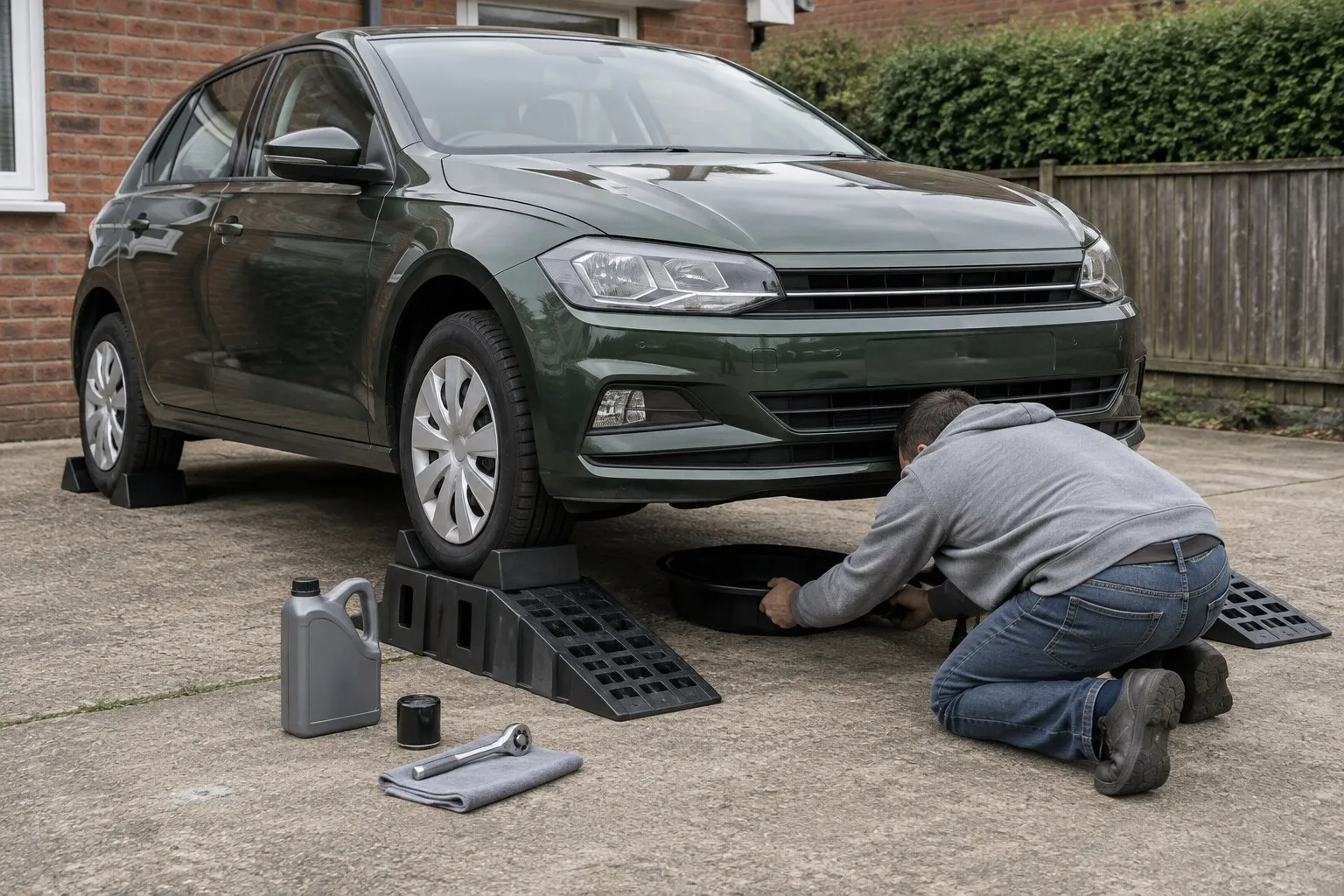
Raise the car safely. Park on firm, level ground and use ramps or axle stands. Never work under a car held up only by a jack. Chock the wheels that stay on the ground.
Remove the oil filler cap. This lets air in so the oil drains freely.
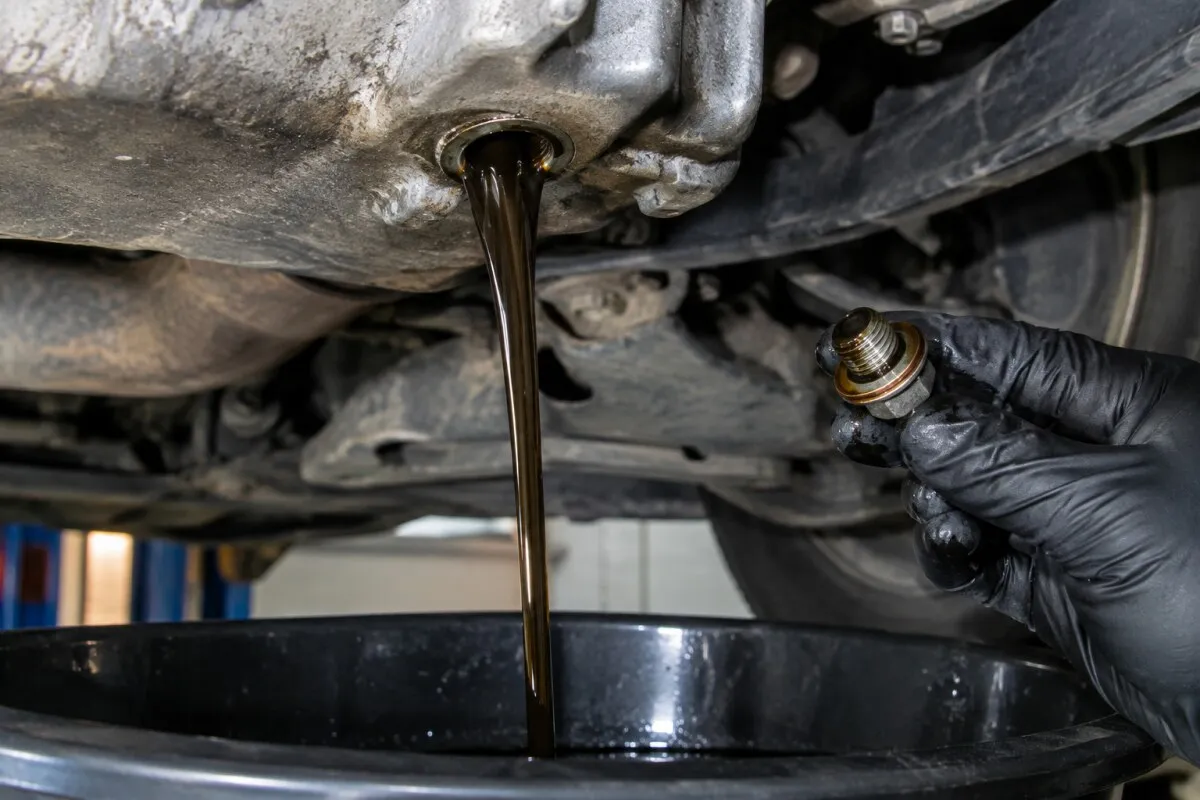
Drain the oil. Put the pan under the sump plug, undo it by hand for the last few turns and let the oil drain completely.
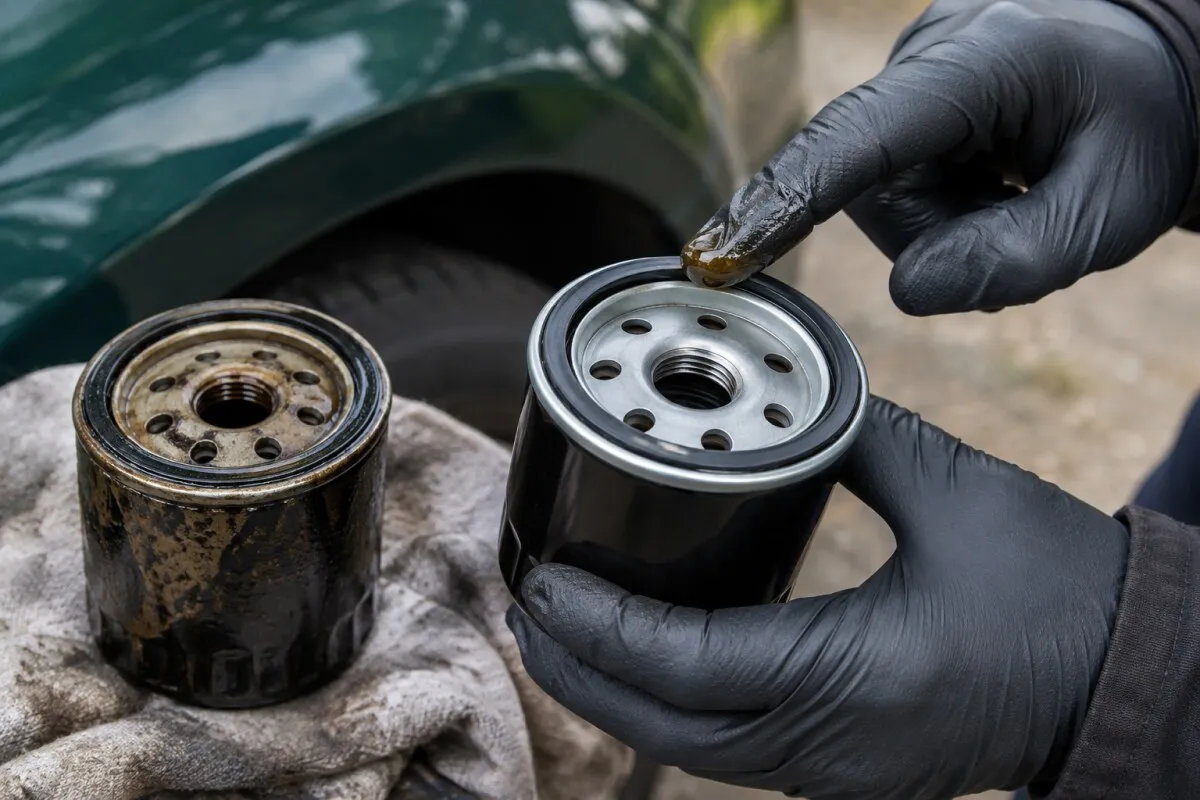
Change the filter. A canister filter unscrews from the engine. A cartridge filter sits inside a housing with a cap, and its sealing rings need replacing too. Smear clean oil on the new filter's rubber seal and fit it as the filter maker instructs, usually hand tight.
Refit the sump plug. Use a new washer, or a new plug where the manufacturer says so, and tighten it to the torque in the manual. Overtightening can strip the thread in the sump.
Refill with oil. Lower the car so it is level. Pour in a little less than the capacity in the handbook, wait a few minutes, check the dipstick and top up in small amounts until it sits near the maximum mark. Do not overfill.
Run the engine and check for leaks. Start it and let it idle for a minute. The oil pressure light should go out within a few seconds. Turn the engine off, look under the car for drips around the plug and filter, wait a few minutes and check the level again.
Reset the service reminder if your car has one, following the handbook.
Record the job with the date, mileage, oil and filter used, and keep the receipts.
Dispose of the old oil properly. Pour it into a sealed container and take it to a household waste recycling centre that accepts engine oil. Not every centre does, so check your council's website first. It is illegal to pour engine oil down a drain or onto the ground. Ask about the old filter too, as many centres collect them separately.
When to leave it to a garage. A garage is the better choice if the car is still under warranty or you cannot raise it safely. The same goes for cars with an electronic oil level sensor and no dipstick, and cars whose service reminder needs a diagnostic tool to reset.
How an Oil Change Shows in Your Service History
Because the oil and filter are changed at every service, this is the job that runs through the whole history. A good invoice lists:
Invoice
What a good oil change invoice lists
- The oil used, with its brand, viscosity and specification, such as "5 litres 5W-30, ACEA C3, VW 504 00".
- The oil filter, ideally with the part number.
- A new sump plug washer or plug.
- The mileage, so the gap between changes can be checked.
The oil specification matters more than it used to. On engines that need a specific oil, such as wet belt engines, a buyer or a warranty provider may want to see that the right oil was used every time. An invoice that only says "oil and filter" cannot show that.
If you change the oil yourself, record it with the oil's specification and keep the receipt and a photo of the bottle label. Our guide to DIY servicing and service history explains how to make a DIY record as convincing as possible.
Buying a Used Car: What to Check
- Look at the gaps between services. Compare the dates and mileages in the history with the schedule for that car. Long gaps mean the oil was left in too long.
- Check the oil specification on the invoices, especially on engines known to be sensitive to the wrong oil.
- Pull the dipstick. The level should be between the marks. Milky deposits under the filler cap can be a sign of short journeys or a head gasket problem.
- Ask when the oil was last changed and look for a sticker or invoice to back it up.
Check the history before you buy
A Service History Check can show recorded services for a car you are thinking of buying, so you can compare them with what the seller has told you.